
Requirements for Spousal Sponsorship
Understand what is required for spousal sponsorship to sponsor your spouse or common law partner for PR.
Let us Understand what Gets a Spousal Sponsorship Approved
Sponsor Must Be a Canadian Citizen or PR
IRPA A130(1)
The sponsor must be at least 18 years old and a Canadian citizen, permanent resident, or registered under the Canadian Indian Act.
Genuine Spousal or Common-Law Relationship
IRPR R4(1)
The relationship must be genuine and not entered into primarily for the purpose of acquiring status under IRPA.
Sponsor Must Meet Financial and Undertaking Obligations
IRPR R132 (1)(b)
The sponsor must sign an undertaking to financially support the sponsored spouse for a set period, and must not be receiving social assistance.
Proof of Cohabitation (for Common-Law Partners)
IRPR R1(1)
Common-law partners must show they have lived together continuously for at least 12 months.
Sponsor Must Not Be Under a Sponsorship Bar
IRPR R133
Certain circumstances, such as defaulting on a previous sponsorship undertaking or specific criminal convictions, can make a sponsor ineligible.
Legally Valid Marriage (for Spouses)
The marriage must be legally valid both where it took place and under Canadian law.
Against All Odds Overturning Spousal Spounshorship Case To Approval Case Study:
How Richfield helped an applicant received PFL from IRCC
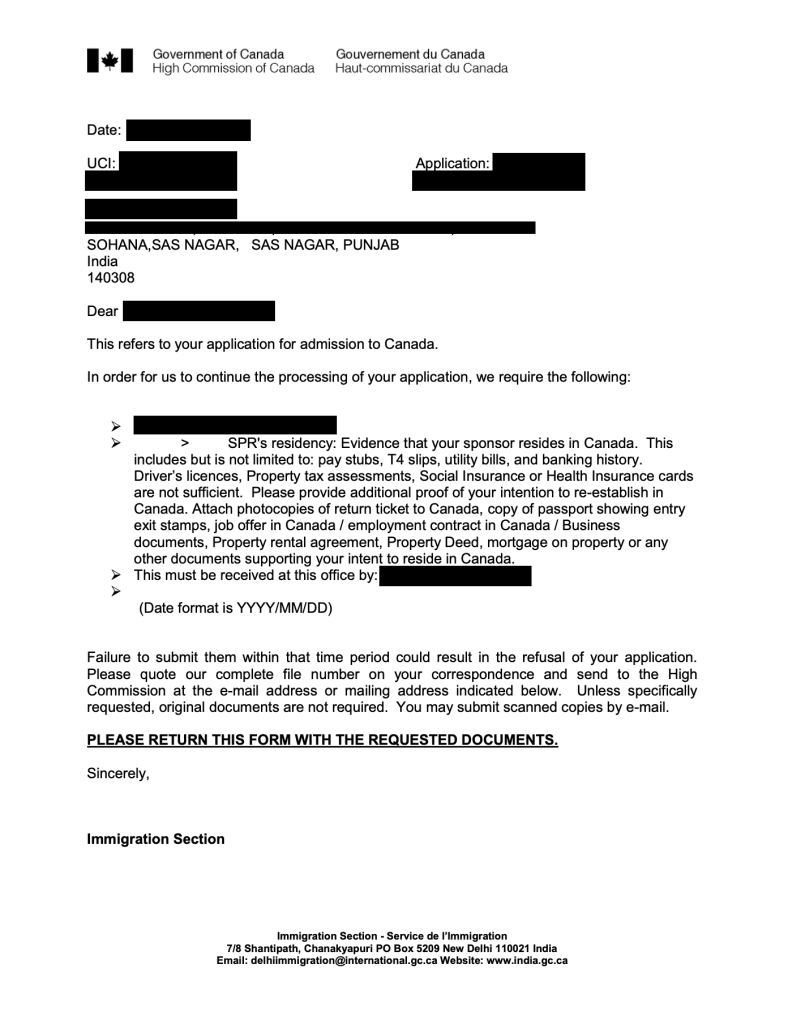
When a Spousal Sponsorship applicant from Chandigarh approached Richfield, she had received a PFL from IRCC.
One of the core requirements for Spousal Sponsorship is that the Sponsor has to be a Canadian citizen or a Permanent Resident of Canada. If the sponsor is a permanent resident, then he or she must be residing in Canada at the time of application and approval.
In this case, the sponsor was a Permanent Resident, had submitted the Sponsorship application when he was outside Canada, had subsequently gone back to Canada, but eventually had left Canada and returned to India. Through his travel records, IRCC had information that the Sponsor had left Canada. IRCC sent an ADR to the applicant, indicating a potential ineligibility of the sponsor to sponsor his wife in India, as he was not residing in Canada. Due to relationship and health reasons, the sponsor could not go back to Canada. It seemed to the family that their future in Canada was over.
This is where Richfield stepped in.
By evaluating their family and health situation in depth, assessing it against the eligibility criteria, Mr. Atamjeet Walia built a strategy around their family’s situation and how the family could defend their eligibility to IRCC, without any risk of misrepresentation.
In such cases, many criteria need to be evaluated, including medical records, relationship substantiation records, financial records, and employment records. One of the most critical issues that may be overlooked is the risk of misrepresentation since there was substantial history of the applicant with the IRCC and situations had changed substantially. To correlate the past, current and future intentions requires careful legal evaluation.
We responded to the ADR with legal submissions and adequate documentation to support the Sponsor’s situation and how he would meet eligibility criteria even though he had left Canada due to unavoidable circumstances. The result was approval of the Spousal Sponsorship received within 1 month. We attained success when the family was on the brink of losing everything they had built so far to establish a future in Canada.
The Profile:
Mrs. Kaur from Mohali, Punjab, with an ADR and a risk of refusal of sponsorship due to ineligibility of the sponsor.
The Challenge:
Medical issues, financial constraints, relationship constraints, and misrepresentation risks.
Our Solution:
Our RCIC evaluated the case from every angle that could be relevant to the case, identified the real issues at hand, and built a legal strategy tailored to the applicant’s family situation, guiding them through each step with careful representation.
The Result:
Sponsorship Approved. After a shocking ADR, doubts about eligibility, and a complex family situation, a carefully rebuilt application turned their lost hope into a successful Canadian Spousal Sponsorship.
Client Review
Mrs. Kaur
What We Do to Strengthen Your Spousal Sponsorship Application

What We Do to Strengthen Your Spousal Sponsorship Case
Genuineness is proven through evidence, not assumptions. We care that you trust your future with us.
- We work with you months in advance of a potential sponsorship application to help you build strong proof of your relationship.
- We confirm sponsor eligibility before the application is built.
- We guide you on where the risks are and where you will benefit legally and financially.
- We help you document your relationship consistently to avoid any issues in the case of an interview with IRCC.
- We anticipate the officer’s likely concerns and address them proactively at the start of an application.
- We review every case through a licensed RCIC.
Our success rates speak for our processes and our expertise.
Frequently Asked Questions (FAQs)
A Canadian citizen or permanent resident, at least 18 years old, who meets the financial and eligibility requirements set by IRCC.
Evidence like communication history, joint finances, photos together, and statements from family or friends can help establish genuineness.
You generally need to show continuous cohabitation for at least 12 months.
Yes, but it may require more detailed evidence to establish that the relationship is genuine, since it doesn’t follow a typical dating pattern.
The application can be affected or refused, since sponsor eligibility is assessed separately from the relationship itself.
Yes, if the officer isn’t convinced the relationship is genuine, or if either party doesn’t meet other eligibility requirements.